
While bamboo will grow in most soils it is important to remember it is not a pond plant or a desert plant. It likes water on a regular basis, particularly in summer. Bamboo likes to grow at the edge of a pond, stream or swampy area but not in it. Irrigation is necessary in the west where summers are dry, clear and hot. In the east where summer rains are a regular occurrence irrigation is not necessary except for newly planted bamboo or under drought conditions. The soil range can be from sandy to clay. In sandy/loamy soils, however, watering and feeding will need to be more frequent. Bamboo Giant Bamboo Soil mix has been specially formulated to provide optimum conditions for maximum growth. A heavy mulch of wood chips encourages rhizome growth and maintains even moisture levels. Soil pH is recommended at between 5.5 and 6.5 or slightly acid for most species. Avoid using lime on bamboo. Generally, species that tolerate drier conditions may do better in higher pH soils. Bamboo are not salt tolerant so plant 100 yards from the ocean. Some varieties such as Temple and Arrow are more salt tolerant and better for ocean front.. Typical spacing is as follows: Space dwarf bamboos 18" apart, medium and tall sizes 3’ apart for hedges and 5’ apart for a grove.
Spreading or Clumping Bamboo
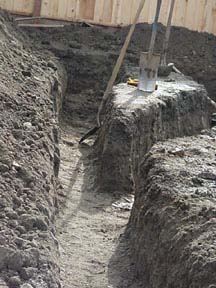
Many gardeners are frightened by the running bamboo species which send out rhizomes that may travel for several feet. These are the culprits of bamboo’s bad reputation among western gardeners. Fortunately, running bamboo can be contained. Clumping bamboo has a different type of rhizome growth that results in the rhizome being very short and, sometimes, almost bulbous. The bamboo that grow only inches away from the center of the plant with densely clustered culms are called clumping bamboo. In basic terms, the spreading or running bamboo are found in the more temperate climates. The clumping bamboo is of more tropical origin. The open grove spreading bamboo is what you may see in photographs of people walking through a forest of bamboo. Clumping bamboo forms tight thickets of canes that are impossible to walk into without cutting your way through first. Most are not very attractive. These are the well behaved bamboo that stay put when planted. The spreading bamboo will easily form an attractive grove. The best way to enjoy spreading bamboo in the garden is in pots above ground or in a designated area with the bamboo contained by rhizome barrier.

Bamboo Giant Soil - the Optimum Mix
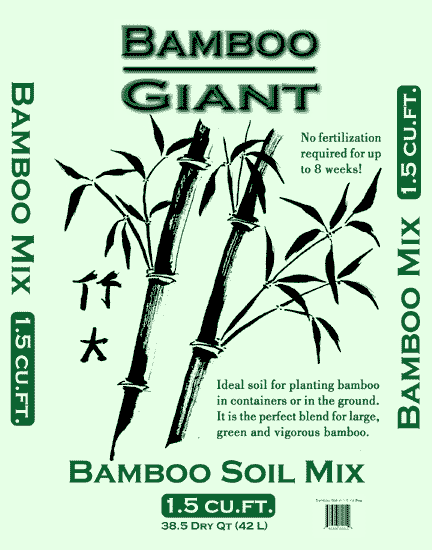
$14.95 per Bamboo Soil Bag (1.5 CuFt)
Our Bamboo Mix is specially formulated for optimum production:
- No need to fertilize for up to 8 weeks!
- Natural Amorphous Silicate from Australia is added for vigorous bamboo growth.
- Uniform blending of ingredients provides air porosity and helps retain moisture.
How much to use:
25 Gallon Plant = 4 Bags
15 Gallon Plant = 2 Bags
5 Gallon Plant = 1 Bag
1 Gallon Plant = 1/2 Bag
3′ Wide Hedge = 1 Bag per linear foot
Instructions for use:
The plants you have purchased are usually ready for immediate planting unless you are instructed otherwise. If it’s very hot and dry when planting, shade the plants for a couple of weeks, and make sure they do not dry out. Don’t keep them waiting for more than a few hours after unwrapping. Unwrap carefully. Avoid breaking tender, new shoots. Clip off any branches or canes that start to dry out.
To plant, follow these instructions:
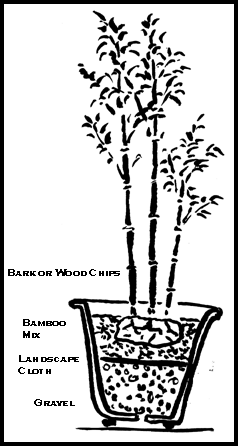
- Dig a hole 6 inches deeper than the container and twice as wide. If your ground is wet and any water accumulates in the hole, fill it in and plant the bamboo above ground, building up the soil around the new plant with Bamboo Mix. Bamboo must not be planted in saturated soil!
- Mix BG Bamboo Mix with the excavated dirt at a one-to-one ratio for the bottom of the hole. Use straight Bamboo Mix around the plant. Discard the excess dirt.
- Carefully remove the bamboo plant from the container. Be careful with new emerging bamboo shoots. These are very tender.
- Place the plant in the hole so that the soil levels match at the top. Backfill the hole and tamp the dirt/Bamboo Mix tightly between the root ball and the sides of the hole. Be sure to fill all voids!
- Build a doughnut-shaped depression around the plant and water until deeply soaked.
- It is important to make sure the bamboo does not dry out during the first summer after planting. The signs of drying out are apparent when the bamboo leaves roll up and become very narrow-looking. A 3-6” mulch of wood chips or bark is desirable.
Fertilizing
Although any grass fertilizer can be used with bamboo, Bamboo Giant Fertilizer and Supplement has all the micro-ingredients needed specifically by bamboo for long term health. In Japan, tests revealed three times the growth on regularly fertilized groves compared to unfertilized ones. Fertilizing the bamboo two or three times per year will keep it healthy but for dramatic growth, use Bamboo supplement every time you water! Of course bamboo just loves composted manures of any kind, just don’t overdo it! The ground must breathe or the roots will rot. Our supplement will also make your bamboo more resistant to aphids.
Bamboo Giant Fertilizer
Our Bamboo Food is a time-release fertilizer specially formulated for optimum production -- A high nitrogen formula with the essential minerals bamboo needs for vigorous growth.
- Promotes healthy bamboo growth
- Contains essential mineral elements
- Improves heat and drought tolerance
- Increases resistance to environmental stress
- Enhances growth for healthier, stronger plants
- Easy to use - apply every 3 months
Fertilizer Instructions for use:
Bamboo Grow 16-8-12 is a slow release fertilizer that lasts up to 3 to 4 months. Applications of this fertilizer provides a slow release of Nitrogen, Phosphorus, and Potassium to the plant. This eliminates the feast or famine associated with conventional soluble fertilizers, and helps insure an ideal level of nutrients for optimum plant nutrition. Bamboo Grow 16-8-12 is basically unaffected by watering because the nutrient release is affected only by change in soil temperature. The release rate of each fertilizer pearl increases as the soil warms, and decreases as the soil cools, therefore corresponding to plant growth needs.
In the North, apply in early spring, early summer, and fall during or after leaf drop but not before the ground freezes. In the South, apply in late winter, early spring, mid-summer and fall.
For running bamboo, apply uniformly over entire bamboo planting area. For best results, apply to the soil prior to mulching. For clumping bamboo, apply evenly on the ground within the drip zone of the plants (spread of branches).
Apply uniformly to soil surface at a rate of 1/4 lb. (1/4 cup) per 10 square feet.
Container Size Rate:
1 Gal. Pot 2 tsp.
5 Gal. Pot 4 Tbls.
15 Gal. Pot 7 Tbls.
25 Gal. Pot 15 Tbls.
Supplement Instructions for use:
Our Bamboo Supplement is a liquid concentrate. It is specially formulated for stronger healthier plants. It also enhances bamboo growth. It contains Potassium and 7.8% amorphous silicate to reduce stress caused by heat, cold, drought, insects and disease.
- It improves heat and drought tolerance
- Increases resistance to environmental stress
- Enhances growth for healthier, stronger plants
- Easy to use - Mix 1/4 to 1/2 teaspoon per gallon with every watering. (1 tsp. = 1:750 ratio) (1 cup = 8 oz = 48 tsp = 16 tbsp)
- Hand Watering - apply every week or two.
- Syphon Mixer (1:15 ratio) - Mix 1/4 cup (2 oz) Bamboo Food per gallon of water.
- Drip Irrigation Injector (1:100 ratio) - Mix 1.25 cups (10 oz) per gallon for injectable concentrate.
- Foliar Application - Mix 1/2 tsp per gallon and spray directly on leaves.
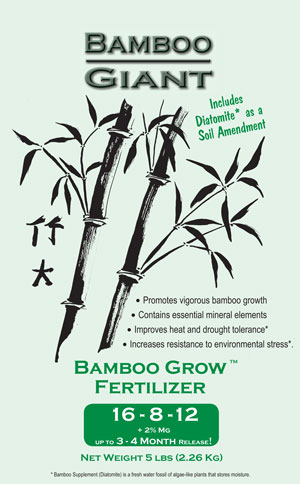
Bamboo Giant Fertilizer - for Maximum Growth and Health
Fertilizer (5 lb Bag)
$19.95
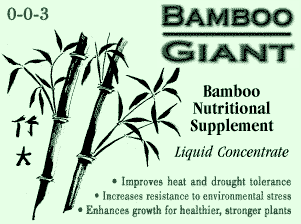
Bamboo Giant Nutritional Supplement - for Stronger Plants
Supplement
$19.95
Bamboo Giant Barrier - a superior solution
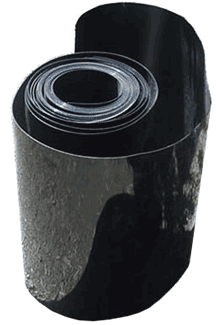
Many materials have been tried for bamboo containment. Concrete cracks, metal rusts most plastics age and crack, rubber is too soft. Polyethylene is the right material but must be thick enough to resist penetration but flexible enough to handle and install. Some may recommend a thin barrier, but we have had customers bring us barrier that is .040 inch thick with a rhizome right through it. Bamboo Giant has formulated a custom barrier material that is .060 thick. It is UV protected for long life and has a plasticizer added to make it easier to work with.
Rolls are 200 feet long and weigh 150 lbs.
Barrier (per foot) $4.99 per foot
Barrier Roll (200 feet) $749 per roll
Maintenance
The key to keeping the bamboo beautiful is in how one prunes and grooms. Remember that once cut, culms will not grow back. Branches may be trimmed off to expose the culm. Green culms in full sun will yellow over time. For a more open look, the older culms need to be thinned out each year and the spaces between them kept even and open. For the largest culms, cut all small new shoots each year.
Pests
Aphids are a minor problem with bamboo. The aphids secrete a sweet material that promotes the growth of sooty mold, resulting in some black spots on the leaves. These will not kill the plants but look unsightly. Aphids can be controlled by releasing large numbers of ladybugs each year. Although not eliminating the aphids, the population is controlled. They can be eliminated entirely by spraying. The other pest common in California is the gopher. They love bamboo and will keep your plants from spreading by eating the new shoots.
Removal
The best way we know of to kill bamboo is by prolonged flooding. In the winter, berm the area around the bamboo and flood for about 2 weeks. Where that is not possible, it all must be dug out. The Bamboo Giant crew is available for removal projects. Leave it to the experts!